Nov 30, 2025
How ChatGPT Finds and Chooses Websites
ChatGPT doesn’t “know” the live internet.
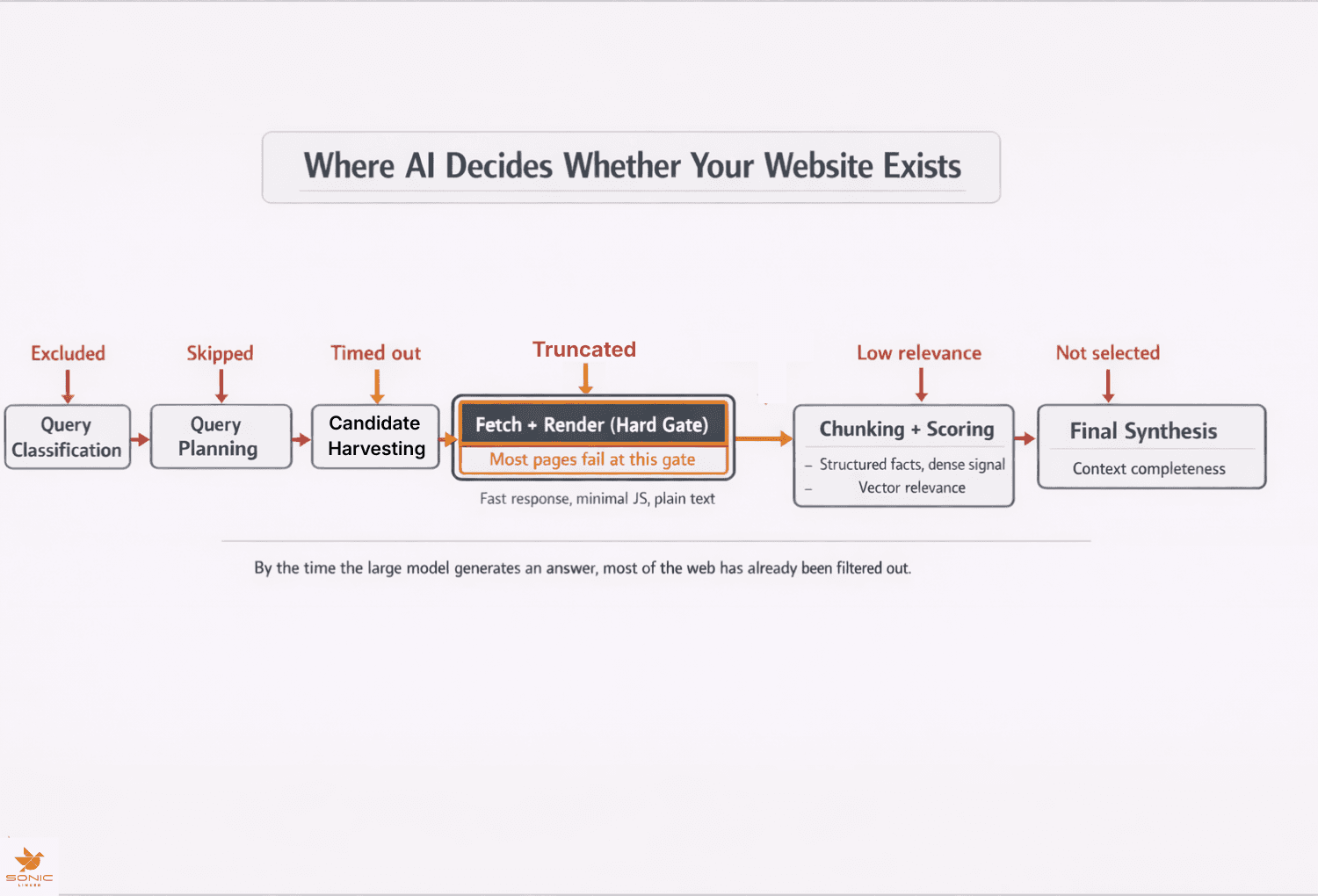
ChatGPT finds and chooses websites by generating search queries, retrieving candidate pages, parsing them under strict time limits, scoring extracted content chunks for relevance, and synthesizing only the highest-confidence sources into an answer.
This is why ChatGPT says ‘pricing not available’ about your product.
Most websites are eliminated long before the model writes anything. If your site fails early in retrieval, your brand doesn’t reach the generation step.
AI visibility is decided upstream by speed, parsability, and extractable clarity, not by design or copy polish.
This process is often described as retrieval-augmented generation (RAG): retrieve first, generate last.
In technical terms, this is a retrieval-augmented generation system, where a search and retrieval layer selects external sources before a large language model generates text from that constrained context window.
The Mental Model Most Teams Get Wrong
Some common assumptions that shape how teams think about AI visibility:
ChatGPT already knows our site.
Good content naturally surfaces.
Brand authority carries over automatically.
Prompting is the main lever.
These assumptions fail for real-world business queries.
Language models are trained on historical data. They don’t have live access to your current pricing, features, inventory, or positioning. When freshness, accuracy, or comparison matters, the system has to retrieve external sources.
Humans infer meaning from layout, visual hierarchy, and context. Machines operate on text extraction, latency limits, and structural reliability. Which is why a page can look excellent to a human and still be invisible to an AI system.
Below is the practical system that determines whether a website is even eligible to influence an answer.
The Retrieval Pipeline Behind a ChatGPT Answer
While implementations keep evolving, the high-level pipeline is generally stable across modern AI systems:
Unlike traditional search engines that build persistent indexes of crawled pages, AI retrieval systems operate closer to real-time fetch and ranking, which means pages must succeed under live latency, rendering, and parsing constraints.
Here is the simplified decision system that determines whether your site ever influences an answer.
Stage | What Happens | Why Sites Fail |
1. Retrieval decision | System decides whether web search is required | Query misunderstood or misclassified |
2. Query generation | Multiple search queries are generated | Site language mismatches search intent |
3. Candidate harvesting | Pages are collected and lightly filtered | Weak titles, vague positioning |
4. Fetch and parsing | Pages fetched under strict time limits | Slow rendering, JS dependency |
5. Chunking and scoring | Content split and scored for relevance | Vague language, low signal density |
6. Source mixing | External sources may outrank site | Third parties are clearer |
7. Answer generation | Model synthesizes final response | Only surviving chunks are used |
Failure at any stage is final. The pages removed early never reach the model. Let’s take a deeper look at each stage
Stage 1 and 2: Deciding What to Search
A small model first decides whether the question can be answered from internal knowledge or requires web retrieval. (Most commercial and operational queries trigger retrieval.)
Next, another model generates search queries. These typically include:
Short keyword queries
Longer intent-based queries
Variations to improve recall
For example, “Which CRM should a 20-person sales team use?” might generate queries related to pricing tiers, feature comparisons, reviews, and deployment size.
This is the first filter. If your language does not align with how problems are searched, your page may never enter the candidate set.
Stage 3: Candidate Harvesting and Early Filtering
The system rapidly collects multiple candidate pages. At this point nothing is deeply read. Lightweight signals dominate:
Title relevance
URL clarity
Domain trust
Basic topical alignment
Pages that appear vague, overly abstract, or misaligned are removed quickly. Marketing language hurts here because it obscures what the page actually contains. There is no benefit of the doubt afforded here.
Stage 4: Speed and Parsability as Hard Gates
Shortlisted pages are fetched in parallel under tight latency budgets often measured in seconds rather than tens of seconds, which effectively creates a crawl budget similar to traditional search but enforced at retrieval time.
This is where a lot of modern sites fail.
Common failure patterns include:
Important facts loaded only after client rendering
Pricing hidden behind toggles or modals
Client-side hydration required to see text
Large markup slowing parsing
Inconsistent responses to automated agents
Rendering determines whether content becomes visible in the DOM, while parsing determines whether that content can be reliably extracted and segmented into usable text for downstream scoring.
If the content doesn’t appear quickly and cleanly in raw HTML or early render output, it may never be processed.
This isn’t a quality judgment. It’s simply a constraint problem. A fast, simple page often beats a slow, complex one even if the slow page is written better.
Stage 5 and 6: Chunking, Scoring, and Source Mixing
Pages that survive fetching are split into small chunks. Each content chunk is converted into a vector embedding and ranked using similarity scoring against the original query intent, which favors dense, explicit statements over narrative or implied meaning.
Only the strongest chunks survive.
Practical consequences:
Narrative structure breaks apart.
Context can be lost.
Vague language scores poorly.
Explicit facts perform best.
Being fetched doesn’t mean being used. At the same time, the system may incorporate other sources such as forums, reviews, documentation, or authoritative summaries.
(These win because they are dense, structured, and unambiguous.)
If your own content is unclear, third-party content may define your brand instead.
Stage 7: Writing the Answer
Only a small curated set of chunks reach the large language model. At this point the model synthesizes rather than explores.
Wording can vary between runs, but the underlying source set usually doesn’t.
You can’t reliably control generation.
But, you can control whether your content reaches it.
If you only optimize copy and UX, you are optimizing the wrong layer.
Generation is probabilistic. Retrieval is constrained and mechanical.
Where Most Websites Break
Most failures are unintentional and come from only optimizing for the human experience.
Typical issues include:
Meaning encoded in visuals instead of text
Key facts hidden behind interactions
Heavy front-end frameworks delaying content
Information scattered across many pages
Marketing copy instead of precise statements
No structured representation of products or policies
Humans can fill in gaps. Machines don’t.
Structured representations such as schema markup, consistent labeling, and predictable page templates increase extraction reliability even when full rendering fails.
A site can convert well for humans and still provide almost no usable signal to AI systems.
From UX Optimization to Retrieval Engineering
Traditional optimization focused on usability, persuasion, and conversion. That definitely still matters.
A second layer now sits underneath it: machine readability and extractability.
Modern optimization involves:
Fast, deterministic rendering
Low-latency delivery for automated fetchers
Plain-text access to critical facts
High information density
Stable, predictable knowledge surfaces
This is not about replacing UX. It is about serving two audiences with different constraints.
Trying to satisfy both perfectly with one surface fails.
What You Can Actually Control
You can’t control how ChatGPT phrases its answers.
What you can control:
How fast your pages respond to automated requests
Whether critical content appears without heavy scripts
Whether facts are expressed clearly in text
Whether content survives chunking and scoring
Whether machines can extract answers reliably
These are engineering decisions, not branding ones.
Visibility Is Decided Before the Model Thinks
By the time ChatGPT writes an answer, most of the web is already filtered out.
AI visibility isn’t driven by clever copy or visual polish. It’s driven by being fast, explicit, and mechanically reliable inside a constrained retrieval system.
Many brands are already invisible to AI systems and don’t know it yet.
The brands that win in this space won’t be the loudest. They’ll be the easiest for machines to understand.
Read more from our blog
Agentic Interfaces and the Future of UX
Jan 28, 2026
By Nikki Diwakar

How Visa Enables AI Agents to Shop and Pay
Jan 26, 2026
By Nikki Diwakar
How To Measure AI Agents When Google Analytics Cannot
Jan 23, 2026
By Nikki Diwakar
How LLMs Discover Your Model Context Protocol and Why It Matters
Jan 19, 2026
By Nikki Diwakar

What You Should Know About Shopify’s Model Context Protocol
Jan 13, 2026
By Nikki Diwakar
B2A Commerce Explained: Winning in an Era of AI Shopping Agents
Jan 12, 2026
By Nikki Diwakar
Agent-First Product Strategy: Building for AI Users, Not Humans
Jan 7, 2026
By Nikki Diwakar
Agentic Commerce Interfaces: How AI Agents Are Rewriting the Buying Experience
Jan 5, 2026
By Nikki Diwakar
ChatGPT Apps just changed how customers buy (quietly)
Dec 31, 2025
By Nikki Diwakar
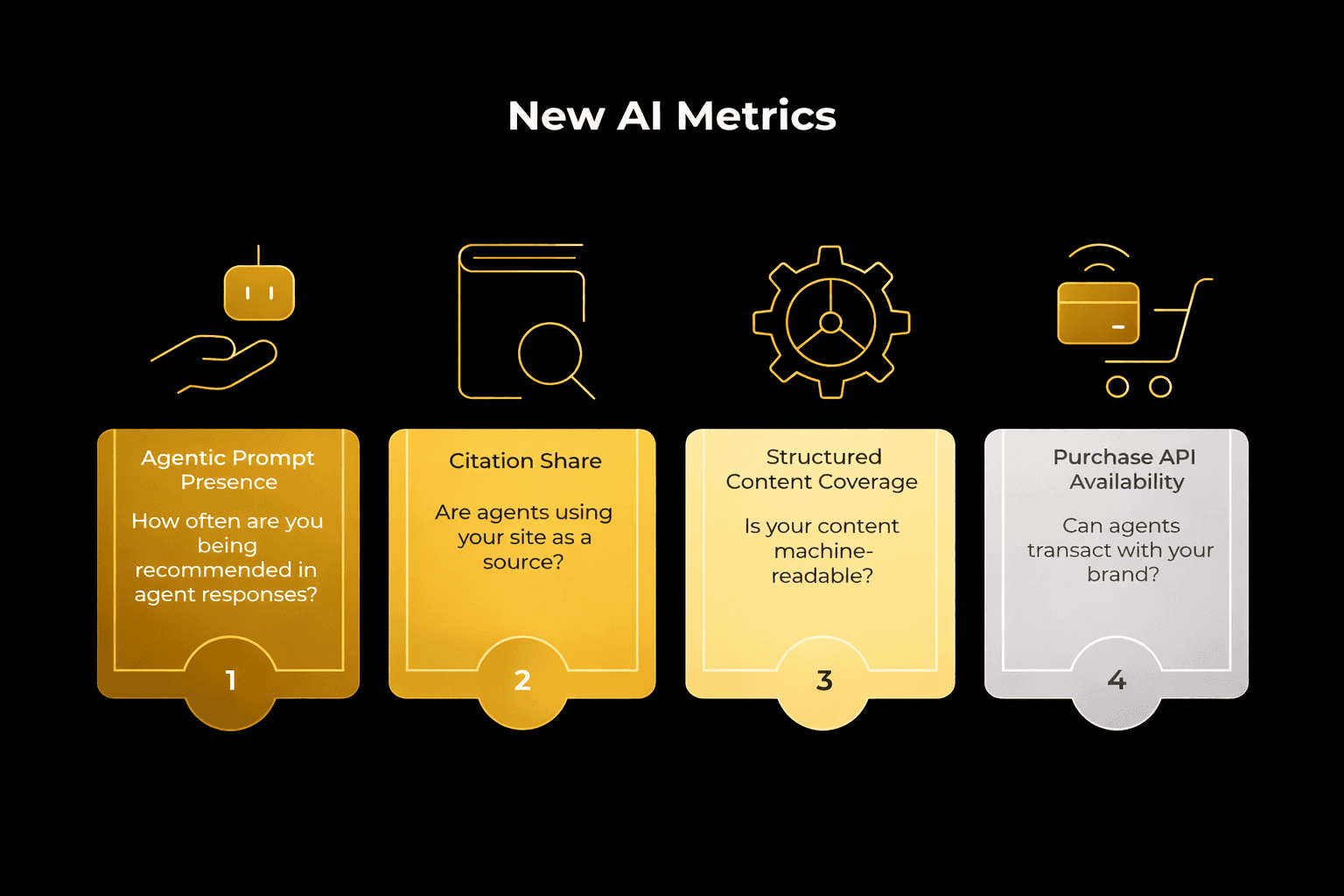
How AI Shopping Agents Change the Sales Funnel and Key Metrics
Dec 26, 2025
By Nikki Diwakar
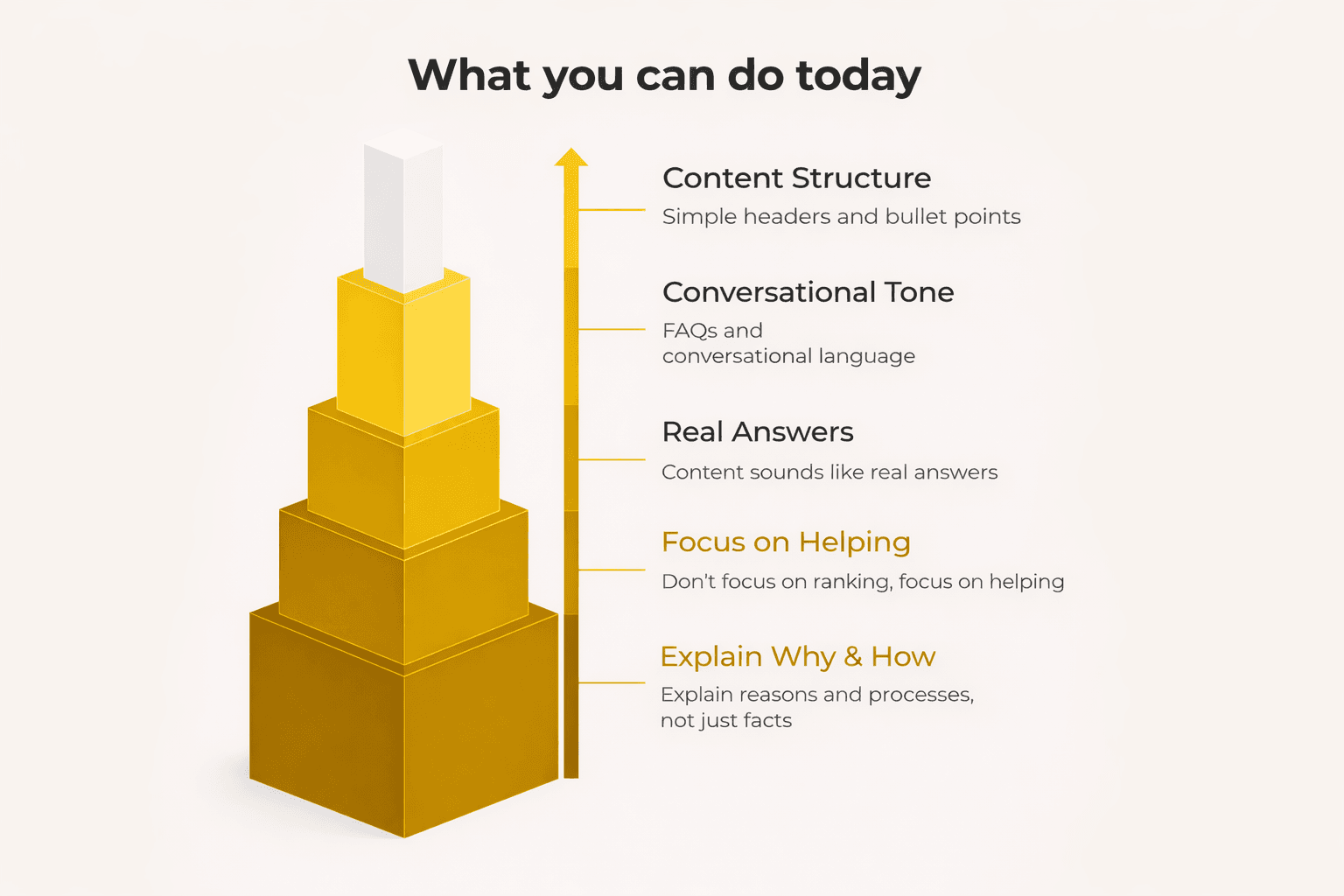
AEO vs. GEO: The New Rules for AI Search Visibility
Dec 15, 2025
By Nikki Diwakar
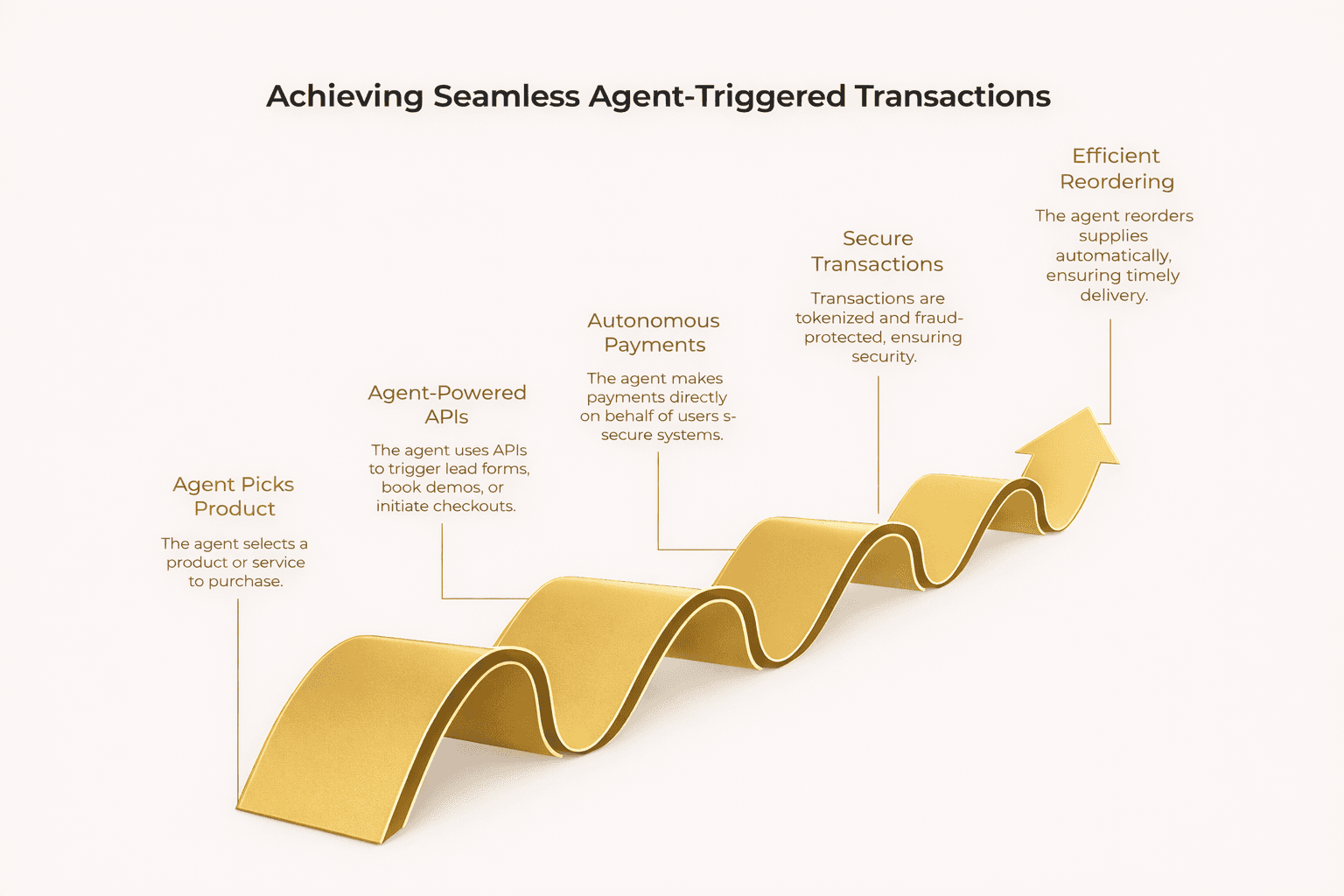
How AI Shopping Agents Work and Why They Matter for Growth
Dec 10, 2025
By Nikki Diwakar

How to Sell on ChatGPT: A Practical Guide to AI Commerce in 2026
Dec 4, 2025
By Nikki Diwakar
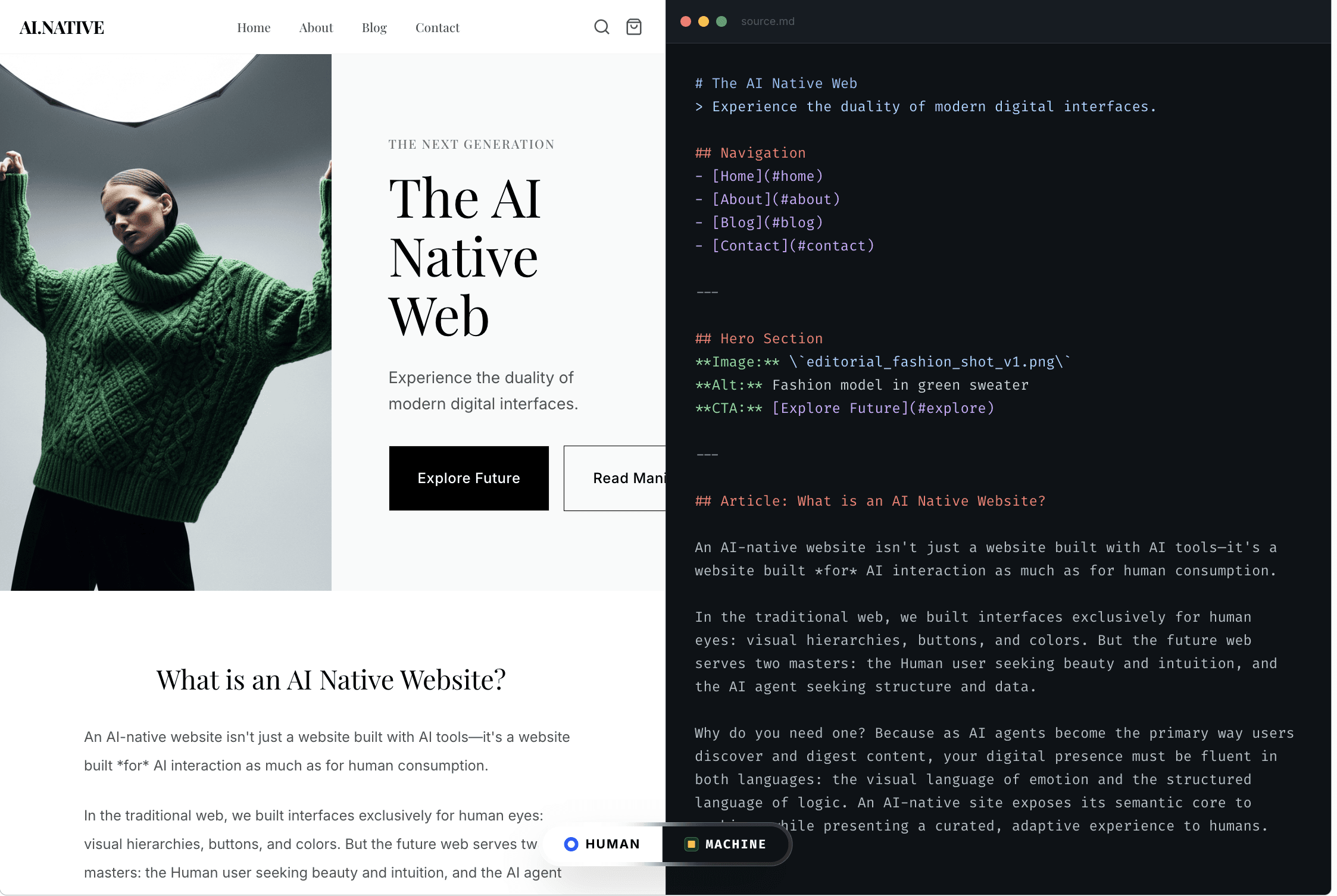
What is an AI-native website and why do you need one?
Nov 30, 2025
By Nikki Diwakar
What Is Vibe Shopping and Why It Matters for Ecommerce Strategy
Nov 21, 2025
By Nikki Diwakar
What your analytics misses: >20% of your “traffic” could be AI agents
Nov 18, 2025
By Nikki Diwakar

Delegated Traffic: When AI agents own 80% of the buyer journey
Oct 21, 2025
By Nikki Diwakar